
What Is Anterior Total Hip Replacement? Benefits & Recovery
If hip arthritis is making it harder to walk, sleep, climb stairs, or enjoy the activities you once loved, you may have started looking into hip replacement surgery.
One question I hear often is: “What is anterior hip replacement, and is it better than the traditional approach?”
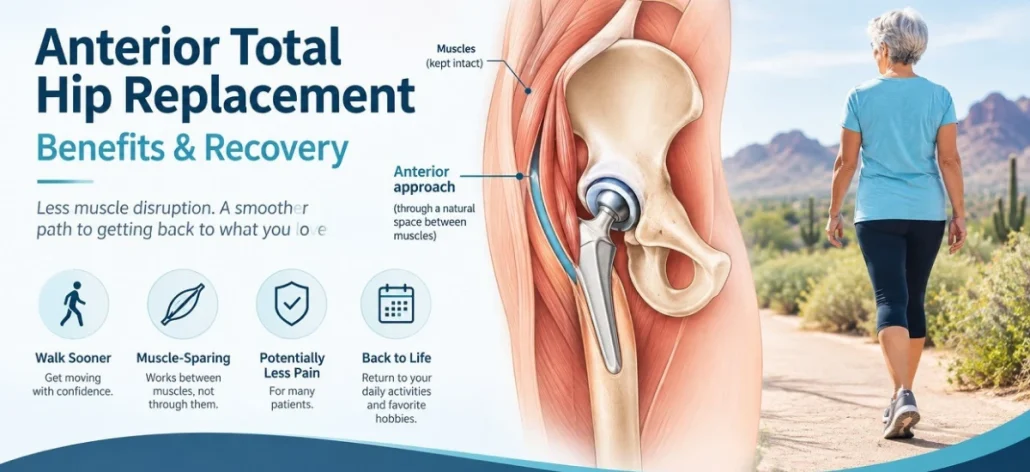
Anterior total hip replacement is one way of performing hip replacement surgery. The surgeon reaches the hip joint from the front of the hip rather than from the back or side.
One of the main reasons patients are interested in the anterior approach is that the surgeon can work between muscles and tissues around the hip instead of cutting through some of those muscles. This may help some patients with early mobility and recovery.
But I want to make one thing clear: anterior hip replacement is not automatically the right choice for every patient. Your anatomy, overall health, activity level, previous surgeries, and the surgeon’s experience all matter when choosing the safest approach.
Understanding Your Hip Before Surgery
Your hip is a ball-and-socket joint.
The ball is the top of your thighbone, called the femoral head. It fits into a rounded socket in your pelvis. Healthy cartilage covers these surfaces and allows the joint to move smoothly.
With arthritis, that cartilage gradually wears away. Eventually, the bones can rub against each other. This can cause pain, stiffness, and loss of motion.
You may notice pain when walking, getting into a car, putting on your shoes, climbing stairs, or getting out of a chair. Some people also develop pain at night.
When these symptoms begin interfering with your everyday life and treatments such as medication, activity changes, injections, or physical therapy no longer provide enough relief, hip replacement may be considered.
What Happens During Anterior Hip Replacement?
During total hip replacement, the damaged ball and socket are replaced with artificial components.
With the anterior approach, the incision is made toward the front of the hip.
Here is a simple way to think about it.
Imagine you need to reach something inside a crowded room. You could move furniture out of the way, or you could find a natural pathway between the furniture and walk through it.
The anterior approach is somewhat similar. The surgeon works through a natural space between muscles and tissues to reach the hip joint.
The goal is to avoid cutting through some of the major muscles around the hip that are important for walking and stability.
This does not mean that the surgery is “muscle-free.” Every hip replacement involves working around muscles, tendons, nerves, blood vessels, and other tissues. The important point is that the anterior approach can allow access to the hip through an interval between muscles.
That is one reason it may be helpful for certain patients.
What Are the Benefits?
Patients often ask whether anterior hip replacement means less pain and a faster recovery.
For some patients, there may be benefits during the early recovery period. These can include:
- Earlier mobility
- Less disruption of certain muscles
- Potentially less early postoperative pain
- Earlier return to some daily activities
- The possibility of going home the same day for appropriately selected patients
But I would not promise that everyone will recover faster simply because the surgery was performed through the front of the hip.
Your recovery depends on many factors, including your general health, strength before surgery, age, activity level, medical conditions, and how your body responds to surgery.
The quality of the entire treatment plan matters—not just where the incision is made.
FAQ’s About Joint Replacement Surgeries | Dr. Matthew Russo, MD
Is Anterior Hip Replacement Better Than Other Approaches?
This is one of the most common questions I hear.
The honest answer is: there is no single approach that is best for every patient.
Anterior, posterior, and other approaches can all be used successfully for total hip replacement.
The right choice depends on your individual situation and your surgeon’s experience.
When I talk with a patient about hip replacement, I look beyond the surgical approach. I want to understand how your hip is affecting your life, what your goals are, and whether you have any factors that could affect surgery or recovery.
The goal is not to choose an approach because it sounds newer or better in an advertisement. The goal is to choose the approach that makes sense for you.
Walking on Your New Hip: Your Recovery Timeline
Every patient heals at a different pace. The timeline below gives you a general idea of what recovery may look like. Your own instructions may be different, and your surgeon’s recommendations should always come first.
Day 1: Getting Up and Moving
What you may feel
- Your hip will be sore.
- Some swelling or bruising is normal.
- You may feel tired from the surgery and anesthesia.
- Your leg may feel weak or unfamiliar at first.
Your mobility goals
- Get out of bed safely with assistance.
- Stand and take your first steps.
- Walk with a walker or other support if needed.
- Learn your exercises and safety instructions.
Surgeon’s Tip
Do not try to prove how strong you are on the first day. Let your care team help you. Your first goal is safe movement, not distance.
Depending on your health, surgery, home situation, and recovery progress, you may be able to go home the same day. Some patients need to stay overnight, and that is perfectly reasonable when additional monitoring or assistance is needed.
Week 1–2: Settling In at Home
What you may feel
- Soreness and swelling should gradually improve.
- You may still need pain medication.
- Sleeping comfortably can be difficult at first.
- You may tire more quickly than expected.
Your mobility goals
- Walk regularly for short periods.
- Continue your prescribed exercises.
- Use your walker until you feel steady and your surgeon or therapist says you can progress.
- Some patients transition to a cane during this period.
Surgeon’s Tip
Do a little at a time. Several short walks are usually more manageable than trying to take one long walk and ending up exhausted.
Weeks 3–6: Building Strength and Confidence
What you may feel
- Pain should continue to decrease.
- Your walking should feel more natural.
- You may still have some stiffness or swelling.
- You may begin feeling more like yourself.
Your mobility goals
- Progress from a walker to a cane when appropriate.
- Gradually increase walking distance.
- Improve hip strength and movement.
- Return to many normal daily activities as your surgeon allows.
Surgeon’s Tip
Do not let a good day fool you into doing too much. Your hip may feel excellent one morning and sore later that evening if you increase your activity too quickly.
Month 3 and Beyond: Getting Back to Your Life
By around three months, many patients have made significant progress.
You may be walking comfortably without a cane and returning to more of your normal activities. Strength and endurance can continue improving beyond this point.
Some patients recover sooner, while others need more time.
Your mobility goals
- Walk comfortably without an assistive device.
- Continue strengthening as recommended.
- Gradually return to appropriate recreational activities.
- Maintain a healthy level of activity to protect your overall joint health.
Surgeon’s Tip
Think long term. A successful hip replacement is not just about feeling better quickly. It is about building good movement habits and taking care of your new joint for years to come.
Three Questions Patients Often Worry About
“Am I going to dislocate my new hip?”
This is a common fear, but you do not need to spend your recovery constantly worrying about your hip popping out of place. I will give you specific movement and activity instructions based on your surgery and individual risk factors, and following those instructions is much more important than being afraid to move.
“When can I drive again?”
You should not drive until you are physically ready, are no longer impaired by medications that affect driving, and can safely control the vehicle and respond in an emergency. The timing varies from patient to patient, so I want you to discuss your specific situation with your surgeon before getting behind the wheel.
“Is physical therapy going to be painful?”
Some soreness is normal when you start moving and strengthening your hip, but therapy should not feel like you are being pushed through severe pain. The goal is steady progress, and your exercise program should be adjusted to your recovery rather than treating every patient exactly the same way.
Happy to help if you have more questions.
When Should You Call Your Surgeon?
Recovery is usually gradual, but you should know when something needs attention.
Contact your surgical team if you develop symptoms such as:
- Increasing redness or drainage from the incision
- Fever or chills
- Severe or worsening pain
- New or significant swelling
- Calf pain or swelling
- Shortness of breath or chest pain
- A sudden change in your ability to walk or use the leg
If you experience severe shortness of breath, chest pain, or another medical emergency, seek emergency medical care immediately. Total Joint Orthopedic Specialist in Scottsdale AZ | Matthew Russo, MD
The Bottom Line
Anterior total hip replacement gives the surgeon access to the hip joint from the front and allows the surgeon to work between certain muscles rather than cutting through some of them.
For the right patient, this approach can be part of a recovery plan designed around early movement and a return to normal activities. But the approach itself is only one piece of the puzzle.
When deciding whether anterior hip replacement is right for you, I consider your anatomy, medical history, lifestyle, goals, and overall health.
If hip arthritis is keeping you from walking comfortably, sleeping well, or doing the things you enjoy, the first step is a careful conversation and examination. From there, we can discuss your options and decide what makes the most sense for you.
About the Author
 Dr. Matthew W. Russo is a third-generation, board-certified and fellowship-trained orthopedic specialist specializing in total hip and knee replacement surgery. He focuses on helping patients understand their treatment options and uses current surgical techniques and technology to provide personalized joint replacement care.
Medical Disclaimer
This article is provided for general educational and informational purposes only. It is not intended to replace professional medical advice, diagnosis, or treatment. Every patient is different, and surgical decisions should be made with a qualified orthopedic surgeon after reviewing your symptoms, medical history, examination findings, imaging, and individual goals. If you have questions about hip pain or hip replacement surgery, speak with your orthopedic surgeon or other qualified healthcare professional.

